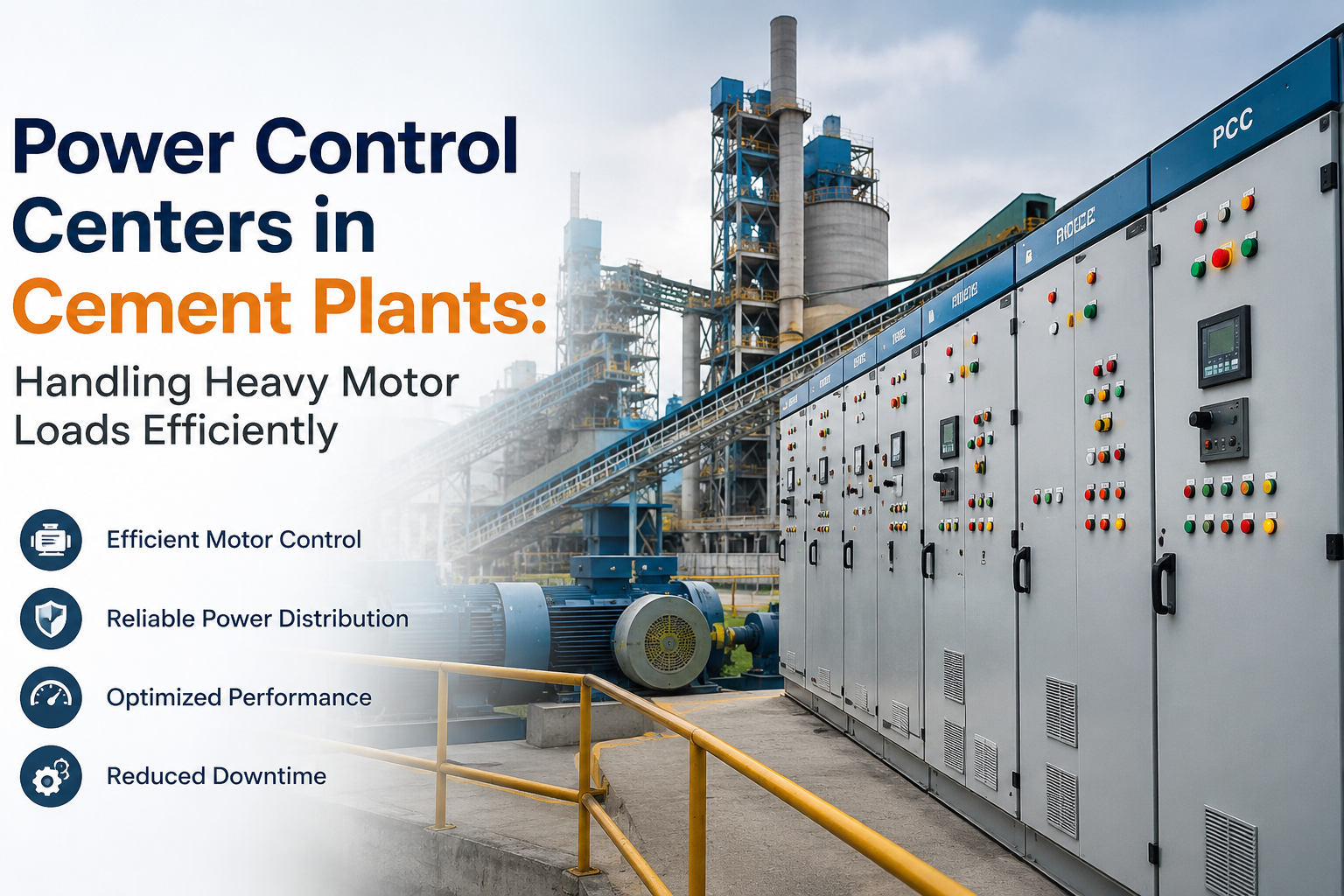
Few industrial environments place as much demand on an electrical distribution system as a cement manufacturing plant. Limestone crushers, raw mills, kiln drives, clinker coolers, conveyors, packing units – nearly every stage of cement production runs on high-capacity motors operating continuously under demanding conditions.
Managing these loads requires more than just supplying power. It requires a centralised system capable of distributing electricity safely, coordinating multiple feeders, and holding stable operation together during fluctuating production demands. That’s exactly where PCC panels for cement plants play a critical role.
A properly engineered Power Control Center (PCC) panel acts as the main distribution hub of the plant — receiving power from transformers or generators and delivering it to downstream MCC panels, process equipment, and heavy-duty motor circuits. In modern cement manufacturing facilities, the reliability of the PCC panel directly influences production continuity and operational efficiency.
The Electrical Demands of a Modern Cement Plant
A cement plant is not a typical industrial facility. Large motors are constantly starting, stopping, and running under variable load conditions. Crushers, induced draft fans, kiln drives, grinding mills — all of them pull substantial current during startup and throughout operation.
Those conditions create real problems for the electrical infrastructure. Voltage fluctuations, high inrush currents, and shifting load profiles across the production cycle put constant pressure on the system.
Because the entire facility depends on these systems running without interruption, PCC panels used in cement manufacturing plants have to be designed for high current distribution while keeping system stability intact. The panel sits at the centre of power routing to every critical production area, which makes it one of the most important assets in the plant’s electrical network.
Feeding the Motors That Drive Production
Most of the electrical consumption in a cement plant comes from motor-driven equipment. Motor Control Centers (MCC panels) handle individual motor circuits, but the PCC panel is the upstream distribution system feeding power to those motor control sections.
A well-designed PCC panel for cement industry applications distributes power evenly across multiple feeders while maintaining solid protection against overloads and short circuits.
Large motor loads create significant current demand – particularly at startup. The PCC panel has to be engineered with appropriately sized busbars, circuit breakers, and feeder arrangements that handle those load characteristics without excessive voltage drop or thermal stress.
In facilities running multiple production lines simultaneously, proper load management isn’t optional. It’s what keeps the overall system efficiency from falling apart.
Why Short-Circuit Strength Matters in Cement Plants
Cement manufacturing facilities typically run large transformers with substantial connected loads. That means the electrical network can see high prospective fault currents when something goes wrong.
The PCC panel short-circuit withstand rating has to be carefully matched to the actual fault levels within the plant. When a fault hits, the panel structure, busbar system, and protection devices all need to handle the fault current safely until the breaker clears the circuit.
In cement plants, electrical faults don’t just create safety risks – they create costly production interruptions.
Properly designed industrial PCC panels address this with robust busbar systems, high-breaking-capacity circuit breakers, and coordinated protection schemes that isolate faults quickly while keeping the rest of the facility running.
Building Reliability Into the Distribution Network
Reliability in a cement plant is measured by how well production continues when conditions get difficult. A short period of downtime hits production targets hard and pushes operating costs up fast.
Modern PCC panels for cement plants are built with that reality in mind. Compartmentalised construction, efficient heat dissipation, and protection relay integration all contribute to stable performance under heavy continuous loads.
Common design priorities include:
- High-current copper busbar systems
- Reliable feeder protection coordination
- Thermal management for continuous operation
- Easy maintenance access
- Long-term operational durability
These aren’t extras – they’re what allows the PCC panel to support demanding production schedules without compromising electrical safety.
Supporting Process Expansion and Future Capacity
Cement plants expand. Production requirements increase, new lines get added, transformer capacity grows. Electrical infrastructure that can’t accommodate that growth creates expensive problems down the line.
A properly planned PCC panel system builds in flexibility – additional feeders, increased transformer capacity, future process equipment upgrades. That scalability reduces the need for major electrical modifications every time production demands shift.
At Synchro Electricals, we design PCC panels for industrial power distribution applications with reliability, scalability, and long-term performance as the core objectives. Load characteristics, fault levels, busbar requirements, and protection coordination all feed into how we engineer solutions for demanding industries like cement manufacturing.
Robust panel construction combined with sound electrical engineering is what produces power distribution systems that genuinely handle heavy motor loads efficiently.
Power Distribution That Keeps Production Moving
A cement plant’s performance depends on its ability to deliver stable power to large motor-driven equipment consistently. A well-designed PCC panel for cement plants is the backbone of that electrical infrastructure – handling safe power distribution, reliable fault protection, and efficient load management all at once.
As cement production facilities push toward higher capacity and greater automation, the importance of dependable industrial PCC panels only increases. Properly engineered Power Control Center panels give plant operators better reliability, room for future expansion, and uninterrupted production in one of the most demanding industrial environments that exists.
FAQs
1. What is the role of a PCC panel in a cement plant?
It distributes power from transformers or generators to MCC panels and major electrical loads across the facility – sitting at the centre of the plant’s entire electrical distribution network.
2. Why do cement plants require high-capacity PCC panels?
Large motors, crushers, mills, and conveyors draw substantial power continuously. The PCC panel has to handle that load reliably without voltage instability or thermal stress.
3. How do PCC panels help manage heavy motor loads?
Through centralised power distribution, feeder protection, and load management, keeping power balanced across the facility even as motor demands shift throughout the production cycle.
4. What protection systems are commonly used in PCC panels?
Overload protection, short-circuit protection, earth fault protection, and coordinated feeder protection schemes are standard in industrial PCC panels for cement applications.
5. Why is fault withstand capability important in cement plant PCC panels?
High fault levels are a reality in cement facilities. Without a strong short-circuit withstand rating, a fault event can damage equipment and shut down production — neither of which is acceptable in a continuous manufacturing environment.